
Tag: fitness

  • Squatting For Beginners

    Squatting For Beginners

    Squatting is Good For You!

    Fundamental movements are movements that are essential for maintaining independent living and enjoying exercise. They include movements such as squatting, lunging, running and hanging. Learning the correct technique to perform fundamental movements is known to reduce the risk of injury in children. It is not only children who benefit from proficiency in these movements. To maintain balance, and thus independence, and to avoid injury, older adults must maintain their ability to perform fundamental movements. 

    Squatting is a particularly important exercise. It is not only foundational to sporting activity but it is also crucial to everyday tasks such as sitting and lifting. Getting up from a sitting is a fundamental task for living independently into old age. The longer we can perform a squat, the longer we will remain independent in old age. 

    Squatting activates the largest muscles in our bodies. The quads, glutes, hamstrings, and calf muscles are all activated during a squat. These large muscles are important not only for movement and balance but also for our metabolism. Muscles act as a store of glucose. They are therefore crucial to how our bodies handle sugar. 

    A squat, when performed correctly, does not compromise the structural integrity of the knees. In fact, it can enhance our stability. This is crucial, as maintaining balance and stability becomes increasingly important as we age. Falling in old age can have disastrous consequences. In addition, squatting, when performed correctly, can improve the stability of the knee and reduce the risk of sports injuries. Being able to squat correctly is a prerequisite to being able to perform more ballistic, explosive movements such as box jumps and plyometrics. The squat mimics the explosive movements required in many sports. Thus, improved squatting enhances sporting performance. 

    Due to its importance in everyday life and because it activates the largest muscles in the body, squatting is fundamental to any resistance training program. Squatting also acts as a useful tool in the doctor’s, physiotherapist’s, or osteopath’s office to screen for any issues with movement mechanics. This is because the squat is what is known as a “compound manoeuvre.” Compound exercises are loved by physical trainers because they require the use of several muscle groups working in collaboration. These exercises are incredibly useful for building muscle mass, strength, and power. As it is a compound movement, squatting is incredibly useful for picking out biomechanical problems. These issues can be due to a lack of muscle strength, an imbalance of strength on each side of the body, unstable joints (also due to a lack of strength), and a lack of joint and muscle flexibility. 

    How to perform a squat

    It is highly recommended that you get an experienced personal trainer or physical therapist to observe your squat technique. This can give you the appropriate cues and feedback to ensure rock-solid technique. It can be really helpful to record your squat movements from the front and the side so that you can see any errors that you are making. 

    If you are new to squatting, you can just use your body weight. Ideally, use a dowel or a light (2.5 kg) strength bar. This allows you to begin in the same position that you will progress to when increasing the weight that you are squatting. Using a cylindrical dowel or light weight bar also engages the muscles around the scapula, helping to stabilise the upper body. 

    Bar – Squatting with weights

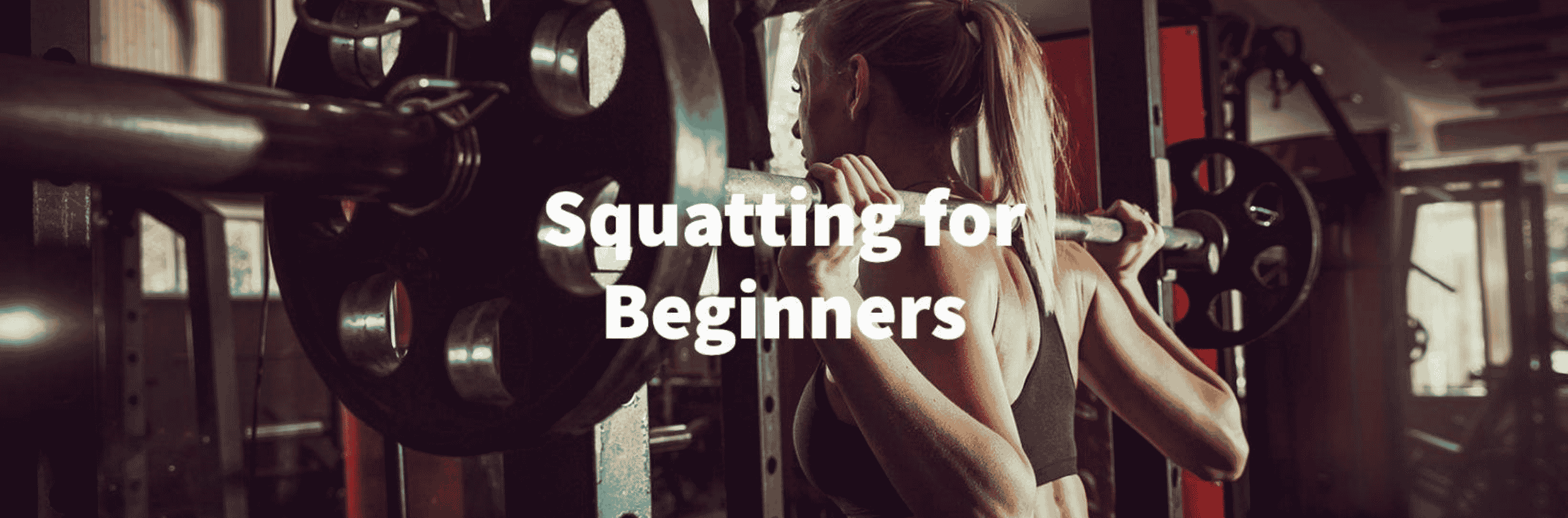
    Begin in a standing position with your feet flat on the floor. Your knees and hips should be in a neutral position, and your spine should be upright with its natural curves preserved. Grip the bar or dowel with the palms facing forward and slightly wider than shoulder width. The bar should rest just below the neck on the upper back. A good tip when using a bar is to “bend the bar.” This action helps brace the torse and improves squat performance. Keep your wrists straight and your forearms parallel to your torso. 

    Stance 

    Stand with your heels shoulder-width apart and your toes pointing forward or slightly outward by no more than ten degrees.

    Breathing 

    Prior to beginning the downward squat motion, breathe in through your nose and down into your belly to about 80% of a full breath. This increases the pressure in the abdomen and helps prepare and brace the spine for the load. Breathe out through the mouth when you are coming back up. This helps to negate the need for a belt.

    Squat Motion

    The descent phase of the squat begins with “breaking the hips.” The motion is that of sitting down while sticking your bum out. It is almost as though you are trying to sit on a chair that is just too far away. The goal should be to keep your bum as far back from your ankles as you can while maintaining an upright torso. The distance between the hips and shoulders should remain constant. The heels should bear the majority of your body weight. The ideal finishing position is with the thighs just below parallel to the ground. The thighs going past the line parallel to the ground are not more likely to result in injury. The speed of the ascent should be 2-4 times the speed of the descent. 

    The upward motion follows the same path as the downward motion. The glutes, or bum muscles, should be the primary driver of the motion. Again, the low back should be kept stiff, and the shoulder and hips should be at the same distance throughout. The weight should be in the heels (I wear shoes with a very minimalist sole to facilitate this although some people squat without shoes). 

    The main, albeit weird, mental cue I think of when performing a squat is that my buns are cracking a walnut. To cue getting my bum out far enough, I imagine that someone could place a walnut between my bum cheeks when I am at the lowest point of the squat (what a job that would be!). I then imagine that I am crushing that walnut with my bum cheeks in the ascent phase. 

    Avoiding Pitfalls

    The squat is a complex movement. There are several ways it can go wrong and result in injury. Here are a few pointers to help maintain the correct technique. 

    Head Position: The gaze should be aimed forwards, and the neck should be perpendicular to the ground. 

    Chest: The chest should be up and the shoulders should be back. So if you have a logo on your t-shirt, you should be able to see it in the mirror. 

    Trunk/Middle: Your trunk should be in line with your shins at all times. 

    Hips: If you are squatting in the mirror, you should see that your hips should be level and parallel to the ground. 

    Knees: Your knees should travel in line with your second toe and should not tilt inward past the inside of your ankle. 

    Feet: The entire sole of the foot should remain in contact with the ground throughout. 

    Squatting is, I think, the most important resistance exercise. If done correctly, it can improve athletic performance, reduce the risk of injury, maintain independence, and improve metabolism. But it is really important to do it correctly. Start with no weight or a very light weight. Ideally, have an experienced personal trainer or physiotherapist observe your squat motion. 
    British Association of Sports and Exercise Medicine  ·  European Atherosclerosis Society  · 
    Independent Doctors Federation

    As seen in The Independent, The Daily Mail and Tatler

    For educational purposes. This article is written by a practising GP and is intended to inform, not replace a consultation with your own doctor. It does not constitute medical advice. A note on clinical guidelines: Coyne Medical is an independent private clinic. Our approach is guided by the best available evidence, tailored to each individual. This may go beyond standard NHS or NICE guidance, which is designed for population-level care and weighted by resource constraints.

  • VO2max Testing

    VO2max Testing

    At Coyne Medical, we are incredibly passionate about the use of exercise as medicine. A huge amount of medical evidence now shows that low levels of fitness are associated with an increased risk of dying from any cause, including heart and vascular disease and cancer rates. In comparison to smoking, having high blood pressure, high cholesterol, or type 2 diabetes mellitus, fitness is a stronger predictor of death. The fitter you are, the lower your chance of dying. The addition of fitness metrics to the standard medical risk variables enables medical professionals to more precisely categorise your disease risk. Being unfit is a massive risk factor for disease. 

    Higher fitness levels are not only associated with a lower risk of death. High fitness is also associated with a lower risk of chronic diseases. The least-fit and next-least-fit groups of people have the most to gain from increased fitness. With increased fitness, these groups have seen a massive reduction in adverse health outcomes. Indeed, bringing VO2 max from the “low” range to merely “below average” reduces mortality by 50%! So there is no need to come anywhere close to the world record of the highest VO2 max of 96.7 ml/kg/min. This highest-ever VO2 max was achieved by Norwegian cyclist Oskar Svendsen. Their cardiovascular risk also declines substantially with increased fitness. Ideally, all adults should have their fitness measured on a regular basis, just like any other preventative check, such as checking blood pressure. The most accurate way to measure your fitness is through a VO2 max test.

    Higher fitness levels are not only associated with a lower risk of death. High fitness is also associated with a lower risk of chronic diseases. The least-fit and next-least-fit groups of people have the most to gain from increased fitness. With increased fitness, these groups have seen a massive reduction in adverse health outcomes. Indeed, bringing VO2 max from the “low” range to merely “below average” reduces mortality by 50%! So there is no need to come anywhere close to the world record of the highest VO2 max of 96.7 ml/kg/min. This highest-ever VO2 max was achieved by Norwegian cyclist Oskar Svendsen. Cardiovascular risk also declines substantially with increased fitness. Ideally, all adults should have their fitness measured on a regular basis, just like any other preventative check, such as checking blood pressure. The most accurate way to measure your fitness is through a VO2 max test. 

    VO2 Max Testing

    VO2 max testing is a form of cardiopulmonary exercise testing (CPET). It is a method used to assess the performance of the heart and lungs at rest and during exercise. VO2 max testing is totally non-invasive. During the test, information about the heart and lungs is collected to understand if the body’s response to exercise is normal. 

    VO2 max, or maximal oxygen consumption, refers to the maximum amount of oxygen that an individual can utilise during intense or maximal exercise. This measurement is generally considered the best indicator of cardiovascular fitness and aerobic endurance. The more oxygen a person can use during high-level exercise, the more energy a person can produce. This test is the gold standard for determining fitness because the muscles need oxygen for prolonged aerobic exercise and the heart must pump adequate amounts of blood through the circulation to meet the demands of the exercise. There is a strong association between VO2 max and longevity. Thus, knowing VO2 max gives us a powerful metric that we know is associated with longevity and that we can objectively improve. That’s right, we can improve our VO2 max. 

    The benefits of VO2 max testing

    Aside from providing the impetus to get fitter in order to live longer, there are several reasons why VO2 max testing is so important:

    • Your current fitness can be accurately measured. This allows doctors to accurately classify your risk of a whole host of diseases. 
    • It allows the capability to create a really efficient, bespoke training programme tailored to you. 
    • It allows the evaluation of the effectiveness of a training programme 
    • It can establish what is optimal running speed or cycling wattage to maximally improve endurance fitness and optimally burn fat
    • It can assist in distinguishing causes of low fitness from cardiac or pulmonary causes
    • From a doctor’s perspective, it can be used to provide helpful prognostic information in those suffering from chronic diseases

    The data obtained from VO2 max testing enables the most precise and standardised quantification of fitness. The primary advantage is the direct measurement of fitness. This is  as opposed to estimating peak or maximal VO2. Establishing exercise intensities (training zones) based on VO2 max testing allows athletes to minimise the risk of injury and fatigue while also enhancing adaptations and responses to the training plan. 

    Older athletes, or those with underlying medical conditions, can also benefit from VO2 max testing. This is because it can provide risk stratification for disease. It also allows safe clearance to participate in sports events. VO2 max can also be used to set training zones and determine exercise limitations for older athletes.

    How VO2 Max is measured

    By putting on a face mask, the volume and gas concentrations of inspired and expired air can be directly measured. This measure is often used in research and is considered the most accurate. The test involves either exercising on a treadmill or a stationary bike. The intensity increases every few minutes until exhaustion. Thus, it is designed to achieve maximal effort. 

    What You Can Learn From VO2 Max Testing

    VO2max testing provided several different metrics that are incredibly useful. 

    • VO2Max
    • This is the maximum amount of oxygen that an individual can utilise during intense or maximal exercise. 
    • As mentioned earlier, there is a strong association between VO2 max and longevity. 
        • It defines the exercise limits of the heart and lungs in healthy people.
        • It decreases with age, 8%-10% per decade in trained individuals who continue to train vigorously. 
        • Men have a VO2 max that is 10%-20% higher than women.
    • Ventilatory Threshold (also known as lactate threshold/ VT1)
        • Anaerobic (without oxygen) metabolism occurs when muscle energy demands exceed oxygen delivery to the muscles.
        • As anaerobic metabolism begins, the breathing rate and breathing effort increase to aid in CO2 removal from the body.
        • At this point, blood lactate levels start to rise, VO2 levels peak, and CO2 production accelerates. Rising lactate levels inhibit performance. So our muscle’s ability to utilise and clear lactate is very important. Training at low intensity helps us clear lactate efficiently. 
        • The measurement sets the upper limit of low-intensity training. 
      • The peak respiratory exchange ratio
        • This is the objective measure of the maximal effort of the participant 
        • It has a huge advantage over estimated maximal heart rate (HRmax), which is often derived from the commonly used equation 220-age
        • When estimated, maximal HR has a large population error of up to 12 bpm and thus is not an ideal indicator of exercise effort
        • Fitness levels have also been shown to influence the decline in maximal HR with age making HRmax even more unreliable. 
    • 2nd Ventilatory threshold (Anaerobic Threshold)
      • At this point. lactate has quickly accumulated in the blood, necessitating heavy breathing to expel CO2.
      • This represents the transition point between moderate and high-intensity exercise.
      • Thus, it sets the limits of high-intensity training

    Implications for Exercise

    Knowing the right intensity to exercise at enables you to maximally improve your fitness performance. Polarised training has been shown to lead to the greatest improvements in endurance performance. This type of training consists of mainly low-intensity, high-volume training (75%).  There is a moderate amount of high-intensity or sprint interval training (20%), and a small amount of training at threshold intensity (5%). Establishing your VT1 and VT2 will help you get the most out of your training. What you can measure, you can manage.  VO2 max is the most accurate way to measure your fitness, and maintaining a high VO2 enhances longevity.

    British Association of Sports and Exercise Medicine  ·  European Atherosclerosis Society  · 
    Independent Doctors Federation

    As seen in The Independent, The Daily Mail and Tatler

    For educational purposes. This article is written by a practising GP and is intended to inform, not replace a consultation with your own doctor. It does not constitute medical advice. A note on clinical guidelines: Coyne Medical is an independent private clinic. Our approach is guided by the best available evidence, tailored to each individual. This may go beyond standard NHS or NICE guidance, which is designed for population-level care and weighted by resource constraints.